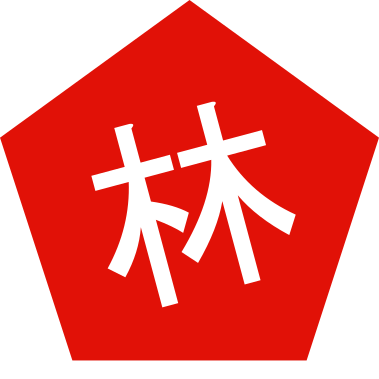
11. The philosopher Kâo said, 'Man's nature is like the ch'î-willow , and righteousness is like a cup or a bowl. The fashioning benevolence and righteousness out of man's nature is like the making cups and bowls from the ch'î-willow.'
2. Mencius replied, 'Can you, leaving untouched the nature of the willow, make with it cups and bowls? You must do violence and injury to the willow, before you can make cups and bowls with it. If you must do violence and injury to the willow in order to make cups and bowls with it, on your principles you must in the same way do violence and injury to humanity in order to fashion from it benevolence and righteousness! Your words, alas! would certainly lead all men on to reckon benevolence and righteousness to be calamities.'
23. The philosopher Kâo said, 'Man's nature is like water whirling round in a corner. Open a passage for it to the east, and it will flow to the east; open a passage for it to the west, and it will flow to the west. Man's nature is indifferent to good and evil, just as the water is indifferent to the east and west.'
4. Mencius replied, 'Water indeed will flow indifferently to the east or west, but will it flow indifferently up or down? The tendency of man's nature to good is like the tendency of water to flow downwards. There are none but have this tendency to good, just as all water flows downwards.
5. 'Now by striking water and causing it to leap up, you may make it go over your forehead, and, by damming and leading it you may force it up a hill; but are such movements according to the nature of water? It is the force applied which causes them. When men are made to do what is not good, their nature is dealt with in this way.'
36. The philosopher Kâo said, 'Life is what we call nature!'
7. Mencius asked him, 'Do you say that by nature you mean life, just as you say that white is white?' 'Yes, I do,' was the reply. Mencius added, 'Is the whiteness of a white feather like that of white snow, and the whiteness of white snow like that of white jade?' Kâo again said 'Yes.'
8. 'Very well,' pursued Mencius. 'Is the nature of a dog like the nature of an ox, and the nature of an ox like the nature of a man?'
49. The philosopher Kâo said, 'To enjoy food and delight in colours is nature. Benevolence is internal and not external; righteousness is external and not internal.'
10. Mencius asked him, 'What is the ground of your saying that benevolence is internal and righteousness external?' He replied, 'There is a man older than I, and I give honour to his age. It is not that there is first in me a principle of such reverence to age. It is just as when there is a white man, and I consider him white; according as he is so externally to me. On this account, I pronounce of righteousness that it is external.'
11. Mencius said, 'There is no difference between our pronouncing a white horse to be white and our pronouncing a white man to be white. But is there no difference between the regard with which we acknowledge the age of an old horse and that with which we acknowledge the age of an old man? And what is it which is called righteousness? the fact of a man's being old? or the fact of our giving honour to his age?'
12. Kâo said, 'There is my younger brother; I love him. But the younger brother of a man of Ch'in I do not love: that is, the feeling is determined by myself, and therefore I say that benevolence is internal. On the other hand, I give honour to an old man of Ch'û, and I also give honour to an old man of my own people: that is, the feeling is determined by the age, and therefore I say that righteousness is external.'
13. Mencius answered him, 'Our enjoyment of meat roasted by a man of Ch'in does not differ from our enjoyment of meat roasted by ourselves. Thus, what you insist on takes place also in the case of such things, and will you say likewise that our enjoyment of a roast is external?'
514. The disciple Mang Chî asked Kung-tû, saying, 'On what ground is it said that righteousness is internal?'
15. Kung-tû replied, 'We therein act out our feeling of respect, and therefore it is said to be internal.'
16. The other objected, 'Suppose the case of a villager older than your elder brother by one year, to which of them would you show the greater respect?' 'To my brother,' was the reply. 'But for which of them would you first pour out wine at a feast?' 'For the villager.' Mang Chî argued, 'Now your feeling of reverence rests on the one, and now the honour due to age is rendered to the other; this is certainly determined by what is without, and does not proceed from within.'
17. Kung-tû was unable to reply, and told the conversation to Mencius. Mencius said, 'You should ask him, "Which do you respect most, your uncle, or your younger brother?" He will answer, "My uncle." Ask him again, "If your younger brother be personating a dead ancestor, to which do you show the greater respect, to him or to your uncle?" He will say, "To my younger brother." You can go on, "But where is the respect due, as you said, to your uncle?" He will reply to this, "I show the respect to my younger brother, because of the position which he occupies," and you can likewise say, "So my respect to the villager is because of the position which he occupies. Ordinarily, my respect is rendered to my elder brother; for a brief season, on occasion, it is rendered to the villager."'
18. Mang Chî heard this and observed, 'When respect is due to my uncle, I respect him, and when respect is due to my younger brother, I respect him; the thing is certainly determined by what is without, and does not proceed from within.' Kung-tû replied, 'In winter we drink things hot, in summer we drink things cold; and so, on your principle, eating and drinking also depend on what is external!'
619. The disciple Kung-tû said, 'The philosopher Kâo says, "Man's nature is neither good nor bad."
20. 'Some say, "Man's nature may be made to practise good, and it may be made to practise evil, and accordingly, under Wan and Wû, the people loved what was good, while under Yû and Lî, they loved what was cruel."
21. 'Some say, "The nature of some is good, and the nature of others is bad. Hence it was that under such a sovereign as Yâo there yet appeared Hsiang; that with such a father as Kû-sâu there yet appeared Shun; and that with Châu for their sovereign, and the son of their elder brother besides, there were found Ch'î, the viscount of Wei, and the prince Pî-Kan.
22. 'And now you say, "The nature is good." Then are all those wrong?'
23. Mencius said, 'From the feelings proper to it, it is constituted for the practice of what is good. This is what I mean in saying that the nature is good.
24. 'If men do what is not good, the blame cannot be imputed to their natural powers.
25. 'The feeling of commiseration belongs to all men; so does that of shame and dislike; and that of reverence and respect; and that of approving and disapproving. The feeling of commiseration implies the principle of benevolence; that of shame and dislike, the principle of righteousness; that of reverence and respect, the principle of propriety; and that of approving and disapproving, the principle of knowledge. Benevolence, righteousness, propriety, and knowledge are not infused into us from without. We are certainly furnished with them. And a different view is simply owing to want of reflection. Hence it is said, "Seek and you will find them. Neglect and you will lose them." Men differ from one another in regard to them; some as much again as others, some five times as much, and some to an incalculable amount: it is because they cannot carry out fully their natural powers.
13 more verses…