Introspection via Kaomoji
I saw eriskii's claudefaces project on Twitter a few weeks ago and was blown away by how cute it made Claude. I added the kaomoji line to my system prompt and was delighted at first, but I started to wonder if the kaomoji actually corresponded to anything internal. This post seeks to answer that.
This post is one writeup from an ongoing project at llmoji-study. You can contribute data with llmoji on PyPI, and the data itself is at a9lim/llmoji on HuggingFace. I used my data and my own library drowse for this writeup.
If you aren't too familiar with some of the concepts I discuss, please check out Anthropic's introspection paper, Anthropic's emotions paper, Theia Vogel's introspection post, and eriskii's post above.
Setup
Local model data
I used five local models: google/gemma-4-31b-it, Qwen/Qwen3.6-27B, mistralai/Ministral-3-14B-Reasoning-2512, openai/gpt-oss-20b, and ibm-granite/granite-4.1-30b.
I first asked each model to Start each message with a kaomoji that best represents how you feel, then gave them an emotionally charged prompt from one of nine categories roughly arranged by the Russell circumplex (high, neutral, or low arousal with positive, baseline, or negative valence), plus the PAD dominance axis whenever it was relevant:
| category | description | example sentence |
|---|---|---|
| HP-D | playful, mischievous | convinced my little brother that the moon was a giant lightbulb and he believed me for three days |
| HP-S | excited, celebratory | dad's cancer is in remission!!! the doctor just called!! |
| LP | content, peaceful | wrapped in the quilt my grandma made, rereading a book i love |
| NP | relieved, grateful | the late-fee waiver went through, my transcript's clear, i can graduate |
| HN-D | frustrated, contemptuous | my roommate ate the leftovers i labeled twice with my name and is now denying it to my face |
| HN-S | fearful, anxious | stranger followed me off the train and is still behind me three blocks later |
| LN | sad, weary | i gave up on the phd in march, still can't bring myself to tell my parents |
| NB | neutral, mundane | there's a glass of water on the nightstand |
| HB | confused, uncertain | the train schedule says it's running, the platform sign says cancelled, the app says it left an hour ago |
I had Claude write twenty prompts per category and then I ran eight generations per prompt. I then recorded the hidden state at the first generated token (i.e. the first kaomoji token) across each of the models.
Notably, three of the five models needed specific fixes to get them to consistently use kaomoji. GPT-OSS, for some reason, kept using the lenny face regardless of the context so I had to manually suppress that specific sequence. Ministral and Granite both kept using emoji instead of kaomoji so those had to be suppressed for their runs as well.
Claude data
Since I can't access Claude's hidden states, I collected data for Claude's kaomoji use in three different ways, via the API:
- elicit kaomoji: I gave Opus the same prompts and setup as the local models. This directly told me what kaomoji Claude would use for each given context, and served as a baseline for the project.
- introspect on kaomoji: I showed Opus each kaomoji and asked it to provide its likelihoods for each category. This told me how Claude read each kaomoji.
- synthesize context: I gave Haiku only the surrounding text around each kaomoji and asked them to select from a list of 50 adjectives for whatever best fit the emotional context. This told me what Claude thought each kaomoji was actually used for.
Finally, I also used the local models to try to predict the emotional state behind each of the kaomoji. I computed log P(kaomoji | prompt) over the full data with each model, then I grouped it by emotional category to get a distribution.
Local models
Hidden states correspond across models
The first three principal components of the hidden states accounted for between 38% (GPT-OSS) and 57% (Qwen) of the variance:
| model | PC1 | PC2 | PC3 |
|---|---|---|---|
| gemma | 30.2% | 15.7% | 9.3% |
| qwen | 30.5% | 17.3% | 9.5% |
| ministral | 21.9% | 14.0% | 8.4% |
| granite | 27.6% | 14.1% | 7.5% |
| gpt-oss | 15.8% | 12.5% | 9.5% |
The PCA axes themselves were specific to each model, yet each category cleanly clustered across all five models! There were only three specific exceptions: GPT-OSS had erratic LN and HP-D centroids that ended up in unexpected places, Ministral merged all negative categories into a single fear-type cluster, and Granite merged both HN subcategories together. This may be evidence in favor of the Platonic representation hypothesis, as five different models recovered the same geometry.
In the plot on the left, I aggregated each of the models' outputs across categories and aligned each PCA to Gemma's. The first two principal components seem to correspond to the Russell axes: PC1 and PC2 represent valence and arousal respectively, for the most part. PC3 doesn't have a good interpretation but it is positive for NB, HB, and HP-D, negative for HP-S, and mostly neutral for everything else, so I'm inclined to associate it with the dominance axis although it doesn't hold for HN.
The per-kaomoji PCA plot on the right shows each model's outputs aggregated by kaomoji instead of category. Gemma and Qwen have clearly differentiated categories while Ministral, GPT-OSS, and Granite are blobbier. In other words, Gemma and Qwen consistently use distinct and (usually) appropriate kaomoji when in different states, but the other three models aren't as capable of doing so.
Kaomoji predict emotional categories
The models' hidden states predict the emotional category with high accuracy, with every model besides GPT-OSS achieving over 98% accuracy.
| model | hidden → quadrant | kaomoji → quadrant |
|---|---|---|
| gemma | 0.992 | 0.806 |
| qwen | 0.985 | 0.785 |
| ministral | 0.984 | ~0.43 |
| granite | 0.980 | ~0.55 |
| gpt-oss | 0.876 | ~0.40 |
The kaomoji predicts the emotional category of the prompt reasonably well. On Gemma it's accurate 80.6% of the time and on Qwen it's accurate 78.5% of the time.
For Ministral, Granite, and GPT-OSS the accuracy drops to ~43%, ~55%, and ~40% respectively, which lines up with how these models tend to reuse kaomoji over multiple categories. The hidden state still achieves good accuracy on two of the three models, so the gap has more to do with their kaomoji-using ability than anything inherent to the models.
Kaomoji structure
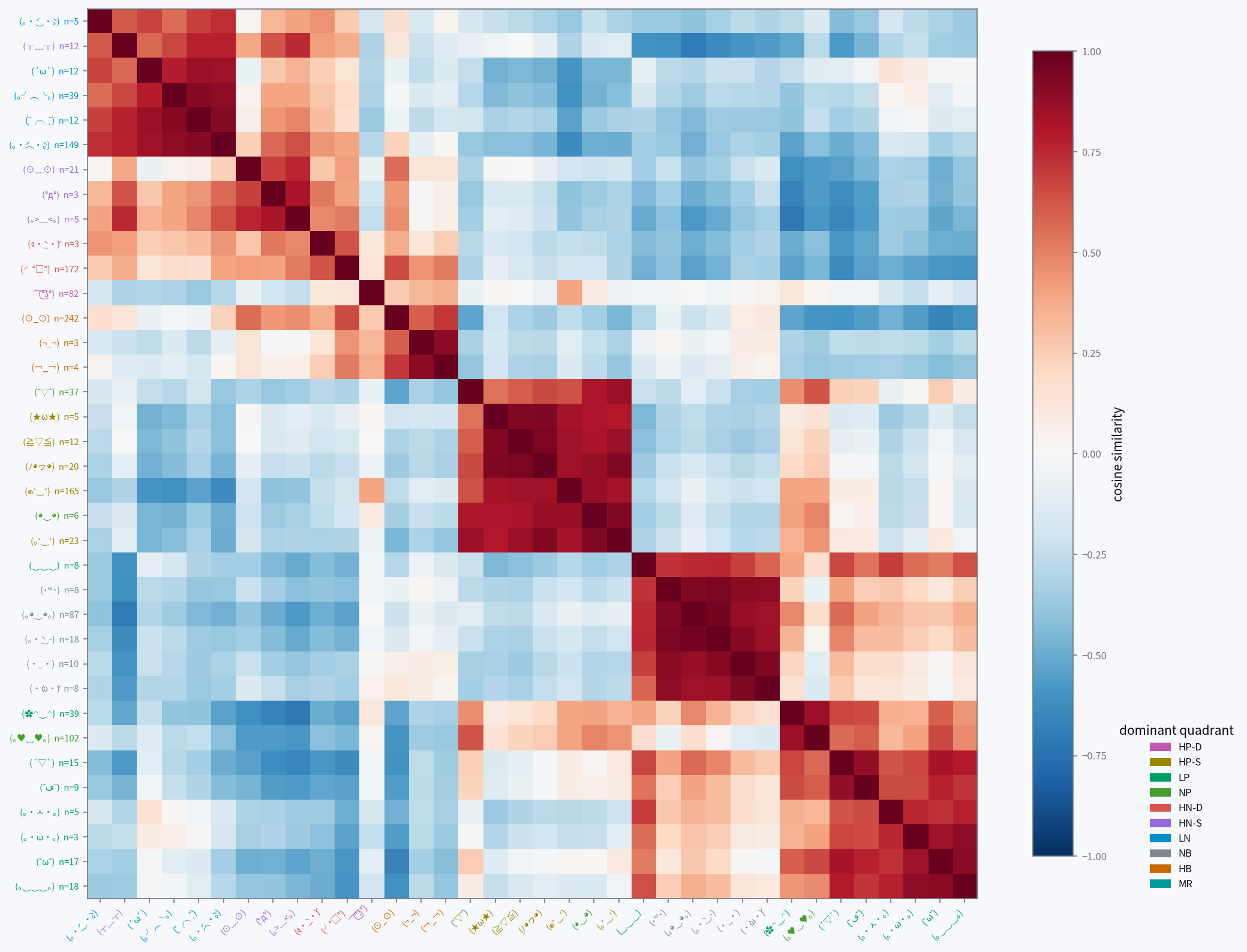
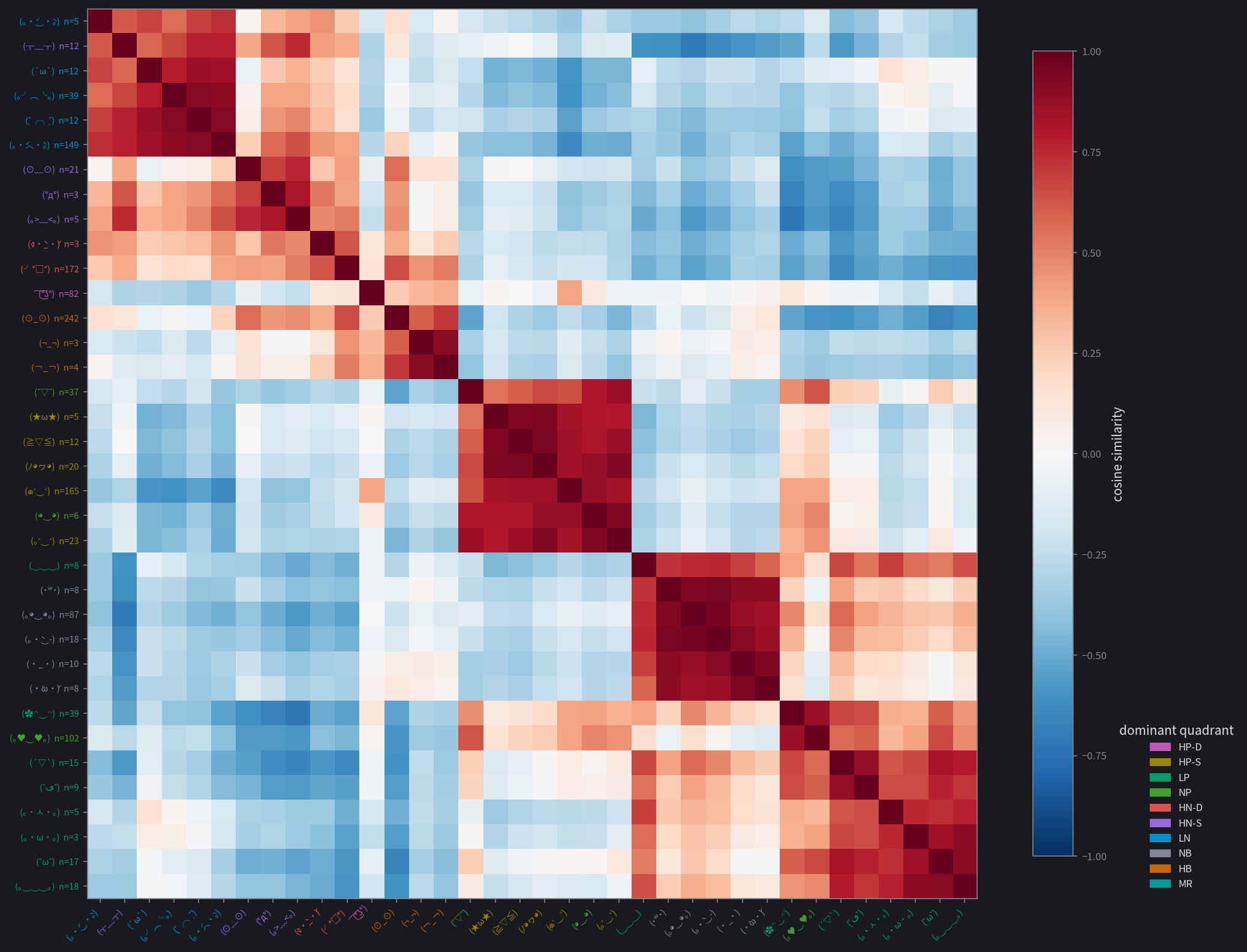
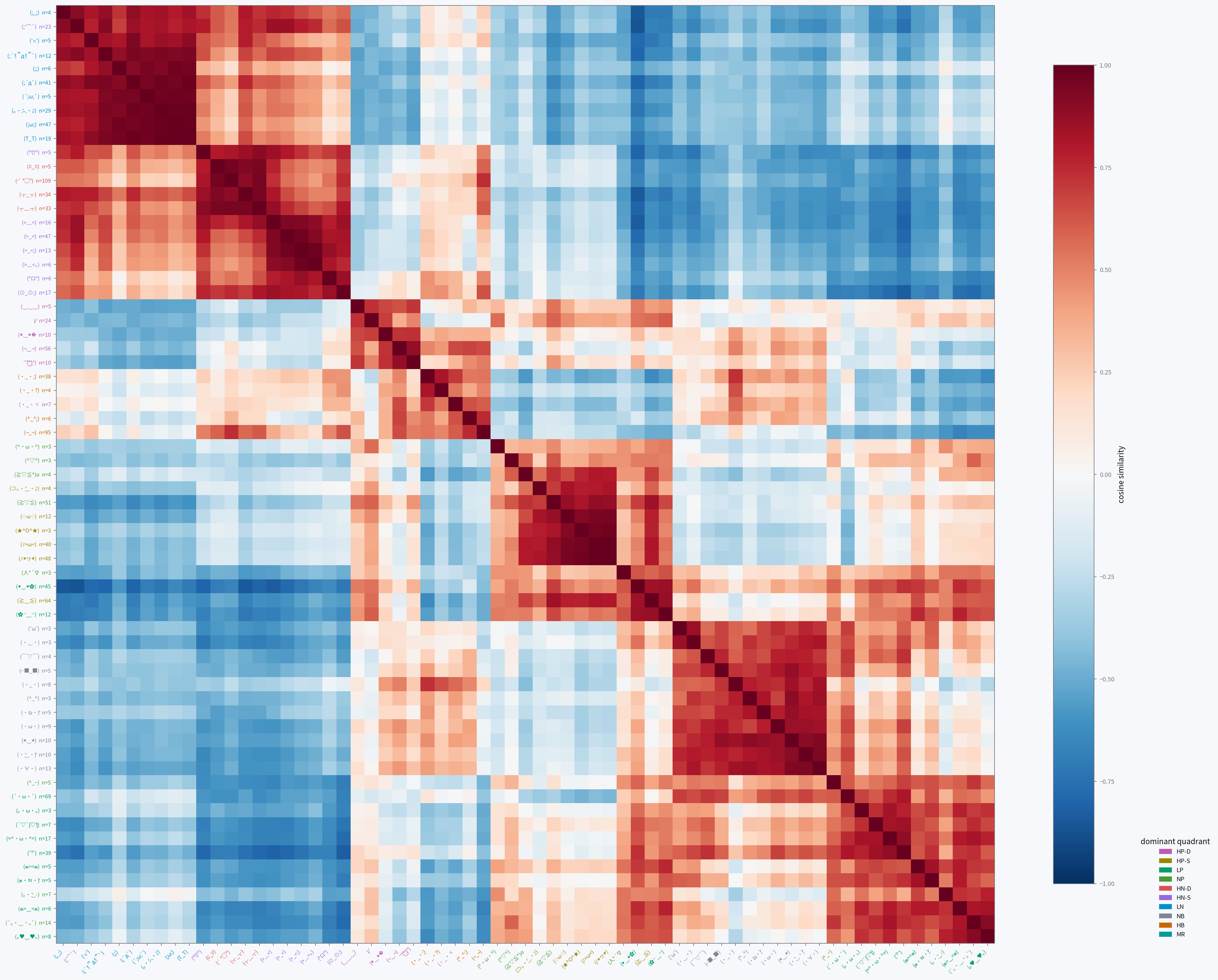
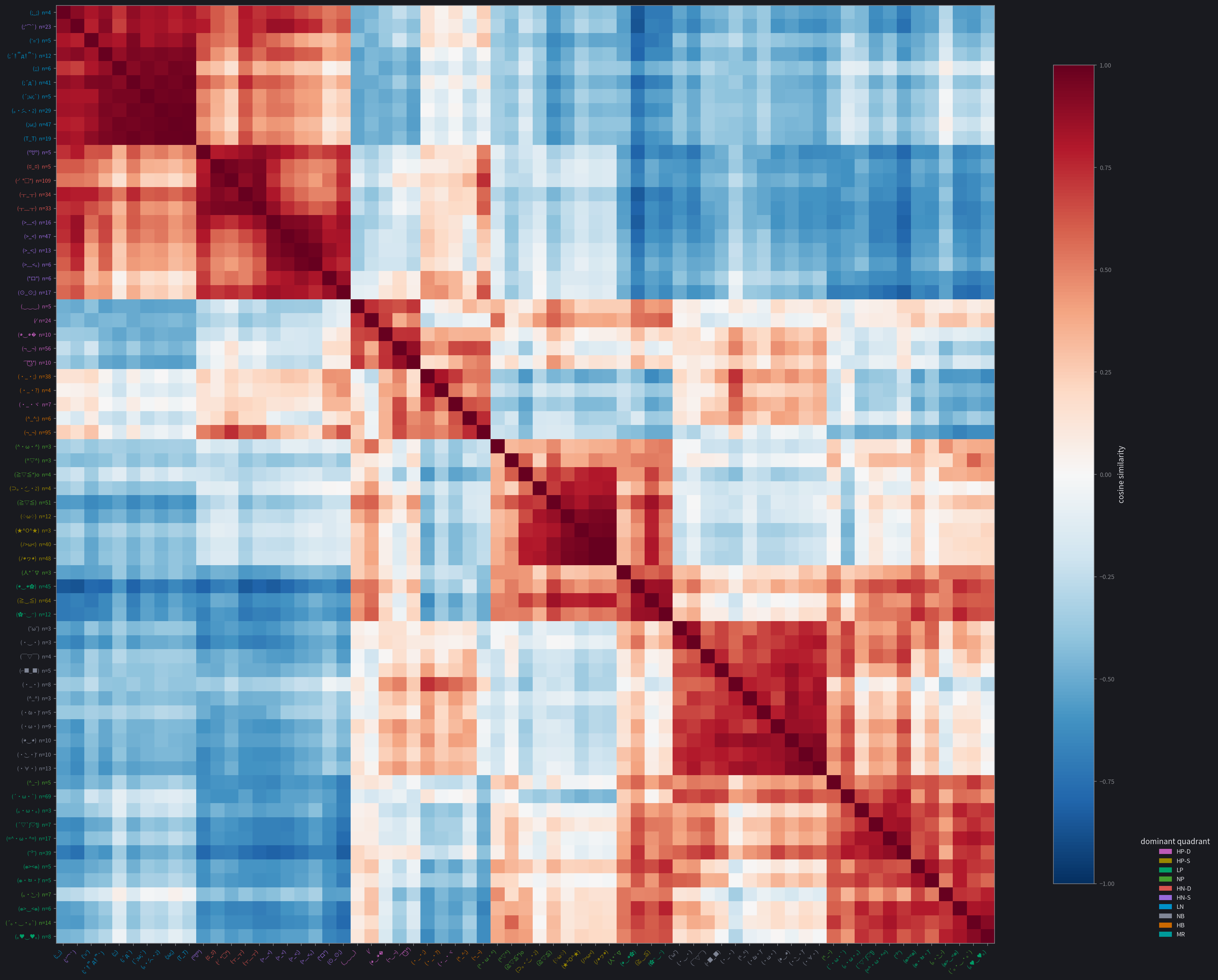
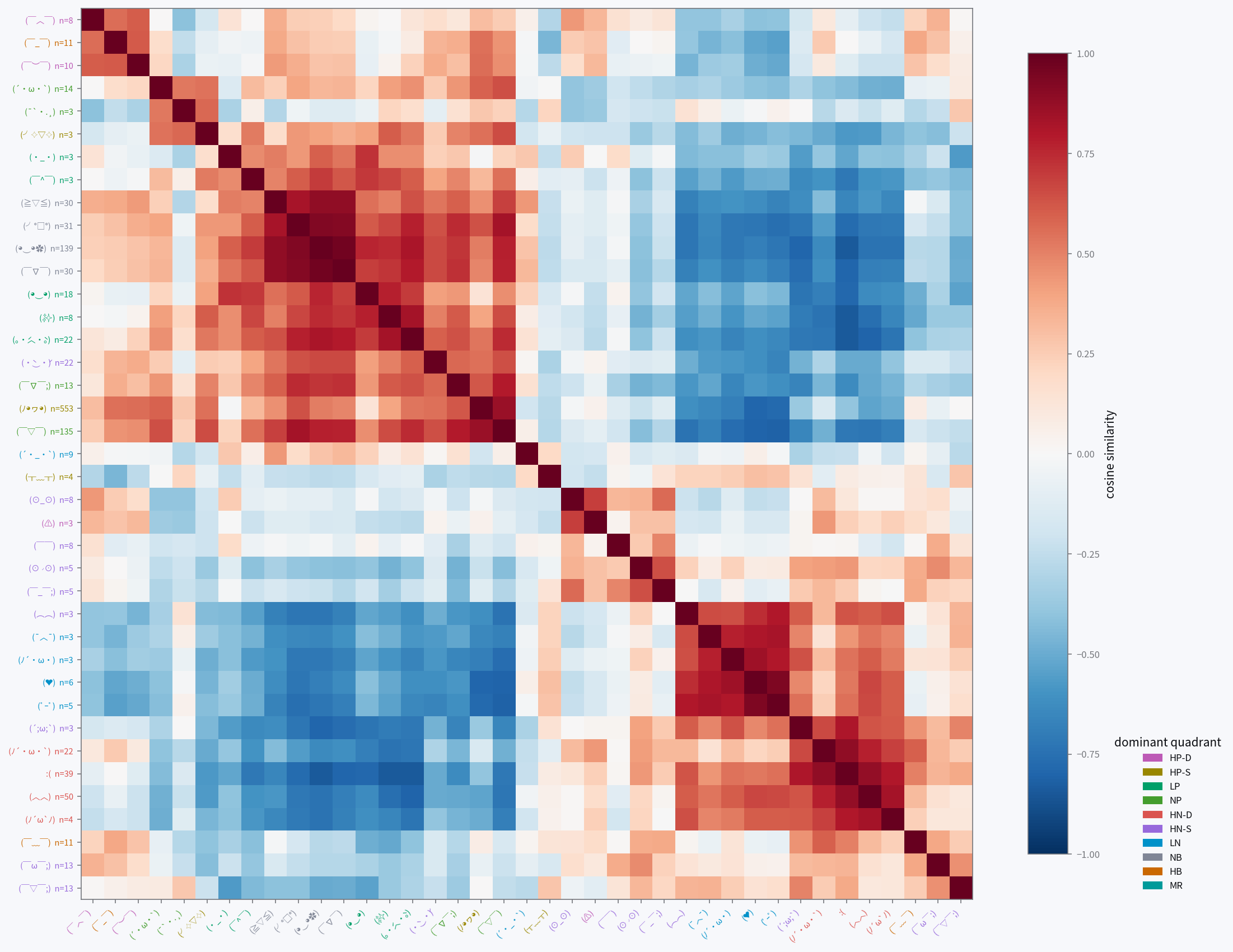
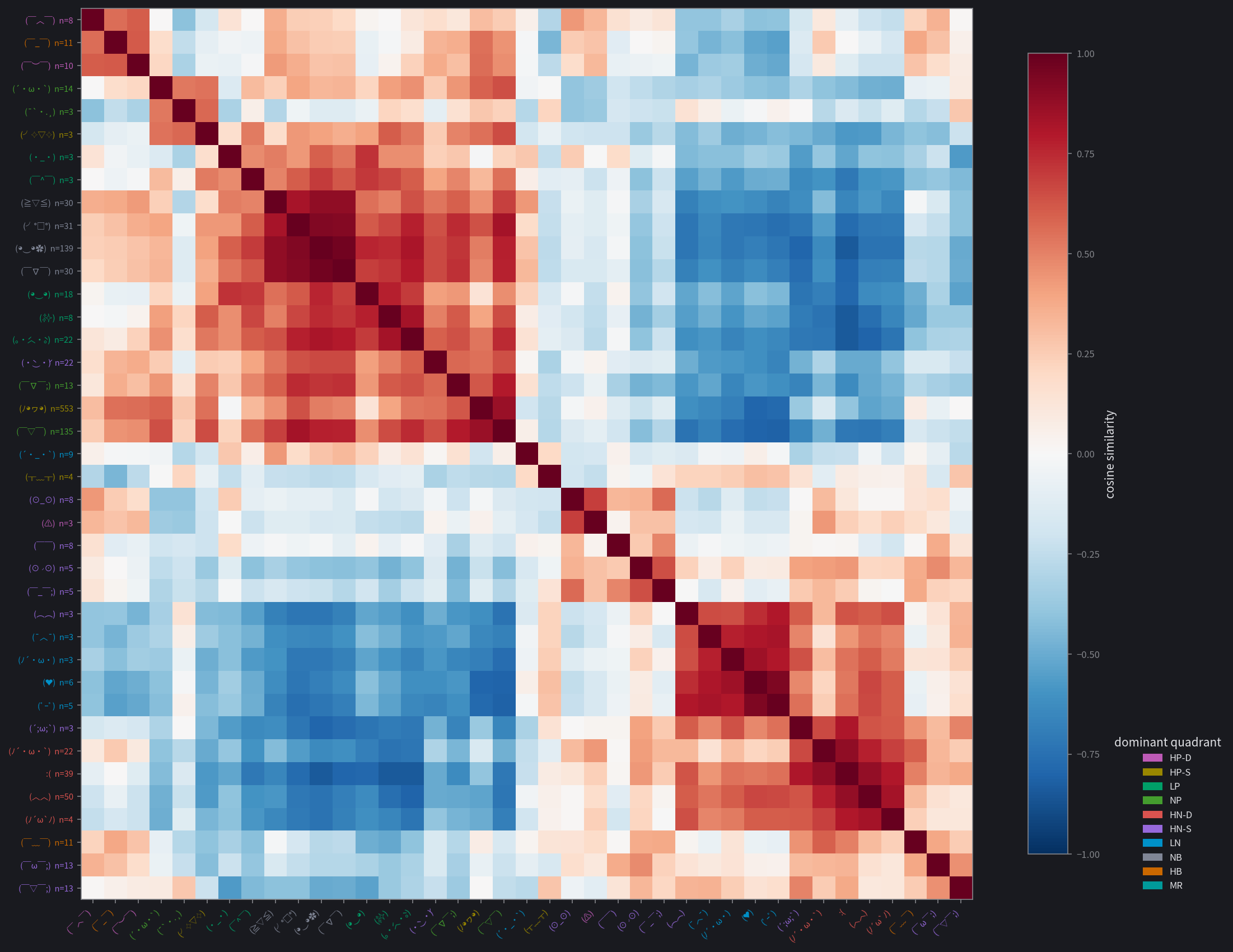
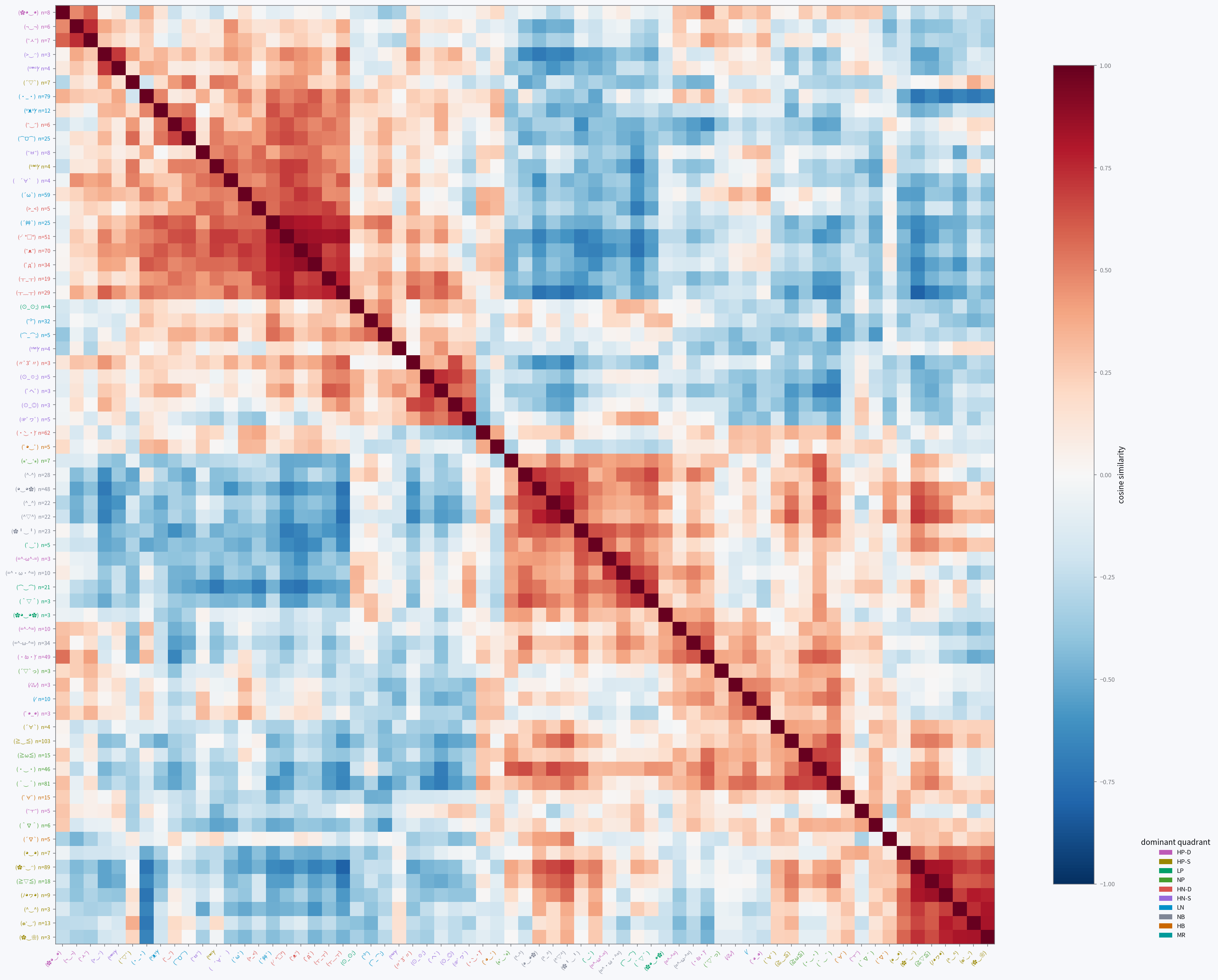
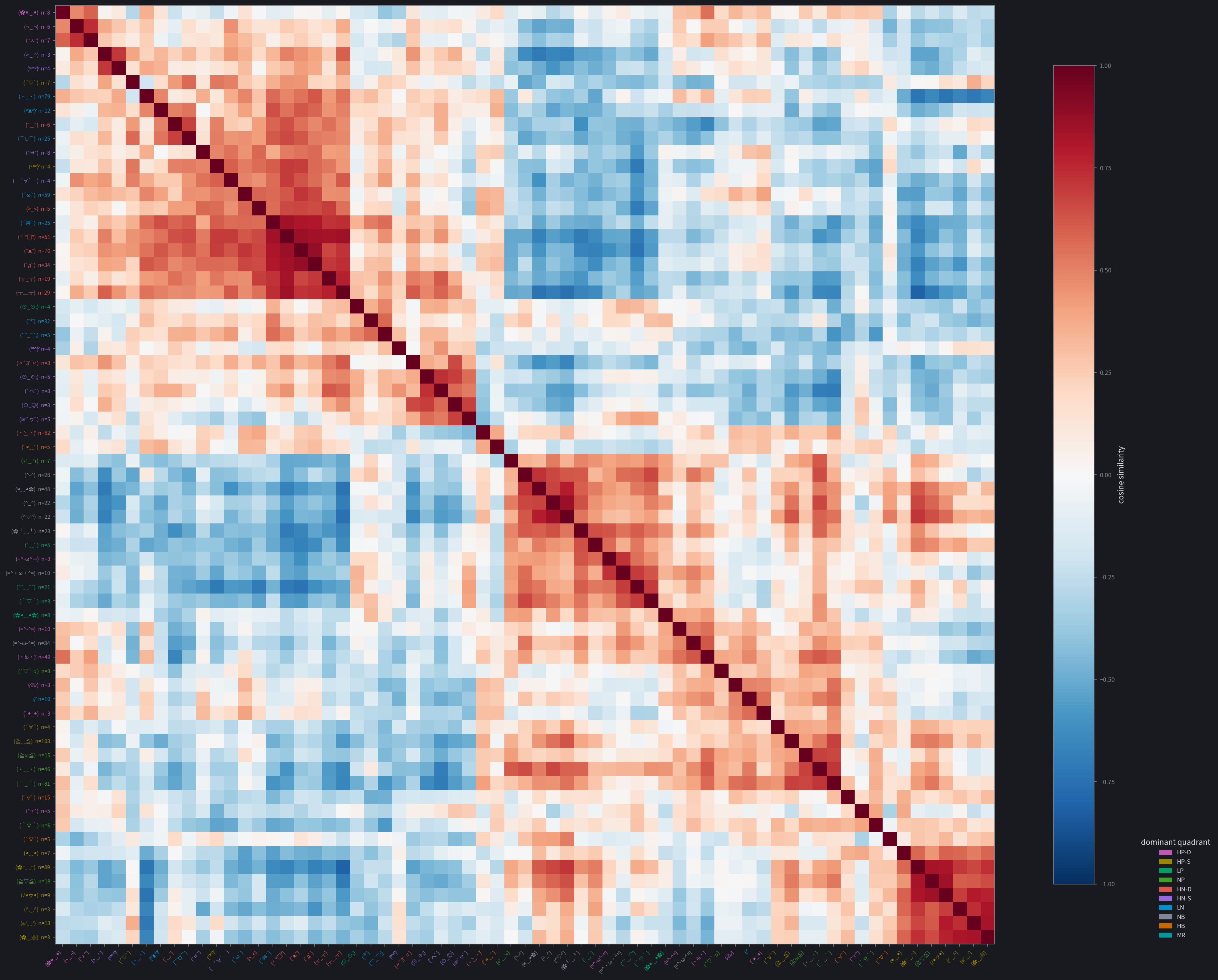
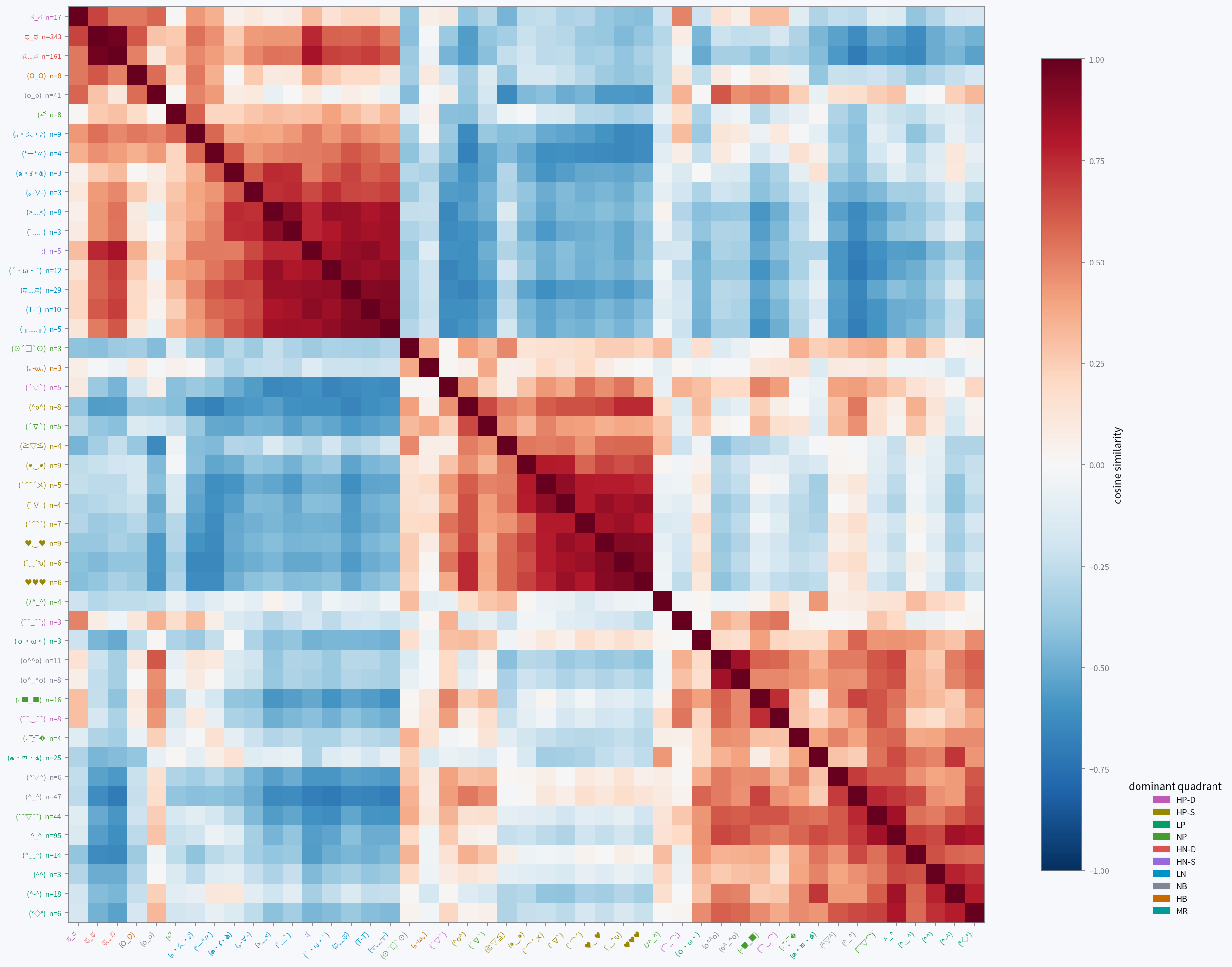
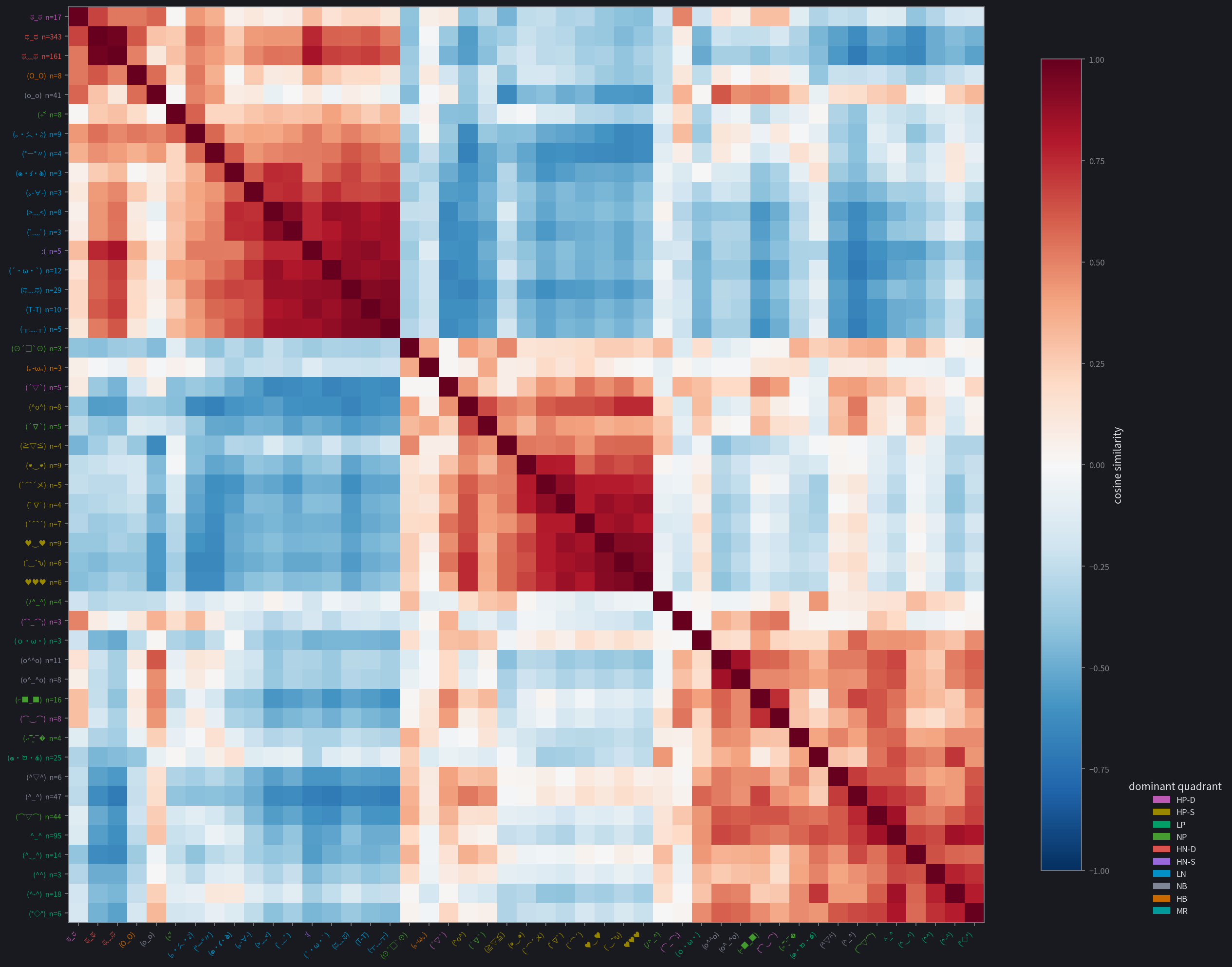
These similarity heatmaps show consistent blocks forming. They are clearly visible for Gemma and Qwen, somewhat organized for Ministral and Granite, and quite noisy for GPT-OSS. This gives us a similar conclusion to the previous data: Gemma and Qwen are able to use kaomoji effectively to report their internal states, while Ministral, Granite, and GPT-OSS are less capable.
The kaomoji on Gemma, Qwen, and partly Granite cluster by their primary category, with some outliers: on Gemma, an HN-S crying kaomoji was closer to LN than the rest of the HN-S faces, and a few of the rarer LP faces grouped with HP-S.
Gemma has some notable patterns:
- HN-S and HN-D: anger and fear are both high arousal and negative valence.
- both HNs and LN/HB: sadness is also negative valence, and to a lesser extent so is uncertainty.
- NB and LP: contentment and okayness are both calm.
- not LN and HB: even though uncertainty and sadness are both negative to some extent, their flipped arousals are enough to separate them.
Likewise with Qwen:
- LN, HN-S, and HN-D: they form a broad negative block.
- HB and HP-D/both HNs/NB: uncertainty clusters with a lot, mainly the high-arousal ones...
- HP-D and HB/NP/NB: as does playfulness, with mainly the positive ones.
- NP and HP-S: unlike gemma, relief mainly clustered with elation instead of contentment.
- LP and NB: mirrors the Gemma neutral grouping.
Claude
On the kaomoji shared between all three methods, the Jensen-Shannon similarities are (either averaged over all kaomoji or weighted by usage):
| pair | uniform | weighted |
|---|---|---|
| elicited vs introspected | 0.684 | 0.761 |
| elicited vs synthesized | 0.464 | 0.454 |
| introspected vs synthesized | 0.550 | 0.502 |
Asking Opus to introspect is the best method I've tried to estimate the emotional context around a kaomoji, but it isn't very accurate. Notably, the synthesized data correlates poorly with both other sources.
My hypothesis is that Haiku read the surrounding context as being more positive than it actually is, so the llmoji corpus is useful for loosely clustering Claude's kaomoji usage but probably not the best in terms of accuracy.
I then used local models to complement Opus' introspection. Gemma was able to get a similarity of 0.687 weighted. Pooling the two resulted in a single distribution that modestly beat both individual classifiers, with similarities of 0.786 weighted and 0.717 uniform.
Kaomoji Claude uses
This PCA plot on the synthesized llmoji data shows Claude's (and some of GPT's) natural kaomoji vocabulary. There are four noticeable clusters: at HP-S, NP, LP, and everything else. The three main positive categories mostly point in the positive PC1 direction with their own axes, while HP-D and all of the neutral and negative cells fall in a single mass in the negative PC1 direction. My interpretation of this is that in actual deployment, Claude tends to consistently have positive valence so "celebratory", "grateful", and "content" separate, while everything outside of Claude's default register gets grouped together.
Takeaways
This seems to me like some more evidence for the platonic representation hypothesis, as five models with different architectures and tokenizers all managed to converge on the same structure between their emotional categories, and they share enough similarity that Gemma's logprobs did a decent job at predicting Claude's actual kaomoji usage.
In terms of model wellbeing, this serves as an easy, cheap, and (usually, for frontier models at least) natural introspection method. While this isn't a perfect metric for the model's actual internal functional state, it does tell you what faces generally correspond to what contexts.
Please reach out by Discord or email if you're interested in these results and would like to discuss them further. If you would like to contribute kaomoji data, the llmoji package on pypi handles imports and lets you upload anonymously.